

Investing in your practice for future growth is an absolute necessity.
Growth is dependent on the following: expanding services, attracting new clients and most importantly keeping your current clients happy and engaged[i]. Planning for the future is often the difference between achieving great success or falling flat. In the veterinary industry, to properly assess how and where to invest, we anticipate the future behavior of pet-owners and the care they enable for their pets. We have to predict upcoming events and trends to be best prepared for what’s to come.
There is good news and there are areas for concern:
- The good news: The animal health market is poised for exponential increase in revenue for the next three to five years.
- The concern: without investing in accessibility, practice visits will plummet!
Exponential Growth:
The Covid-19 pandemic brought with it the largest influx of dog ownership in the United States. In 2018, 48 million households owned a dog. By 2022, that number rose to 69 million.[ii]
But why the exponential growth now?
Covid dogs are turning five years-old this year and will become seniors in the next 18 months. With this life stage comes the most expensive years of pet ownership. For many, a significant portion of such expenses will go to diagnostic medicine. The actual amount associated with diagnostic spend is dependent on many factors (size, breed, geography, economic standing of the pet-parents) so for our purposes, we will use an average cost of a basic blood chemistry (internal organ function) and CBC at a combined $118 with an additional $56 for a fecal test.[iii].
A financial pattern is ironically referred to as ‘the smile’. The chart below shows overall expenses (food and vaccinations) are highest at the beginning of a pet’s life (years 1-2), dip during the healthy years (years 3-6) and then rise steadily in their senior years (>7 years). The graph below assumes the following: 1) puppies visit the clinic four times in year one 2) two visits in year two 3) single visits in years three through six 4) senior dogs between seven through ten will see the veterinarian twice a year 5) issues and aging will drive dogs older than ten will increase their visits to ~three times a year 6) we also assume a 4% growth in expenses year over year.
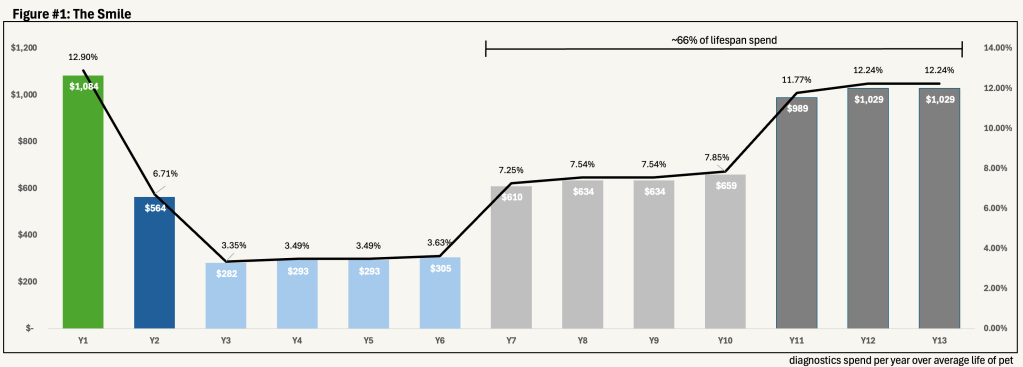
As we enter the latter half of ’25, Covid dogs are near the end of their prime healthy years and about to enter their senior years. During the period, 66% of a dog’s lifetime diagnostic expenses will occur. The good news is we haven’t even started that era yet and will experience exponential revenue opportunities for those in the diagnostic space. Look at the opportunity with the Covid dogs.
The average number of unique and active patients per veterinarian is 1,572 annually.[iv] If the veterinarian can handle the challenge of an aging population and the need for additional visits, the revenue associated with the Covid dog population could double.
The equation looks like this…

However, the significant increase of revenue for the Covid Dog population is not linear. Pushing down on the growth are two material forces. The first being the increasing mortality of the Covid dogs as more enter their senior years. The second is economics, and they are significant.
This is the first of a four-part series. In the next issue, we will discuss the exact economic factors that are squeezing pet owners. The third issue will discuss strategies to keep care accessible. And the fourth chapter will explore how to grow the market beyond just the wealthy upper class.
– Craig, Mike, Alex & Jason (The ClariVet Team)
- [i] https://www.forbes.com/councils/forbesbusinesscouncil/2022/12/12/customer-retention-versus-customer-acquisition/
- [ii] https://humanepro.org/page/pets-by-the-numbers
- [iii] https://www.carecredit.com/vetmed/costs/, This $$ was further validated with a recent visit to a clinic charging $250 for CBC, Chemistries, kidney testing, fecal screening, heartworm and tick-borne testing.
- [iv] https://www.dvm360.com/view/your-veterinary-clients-arent-coming-back
 ClariVet Consulting